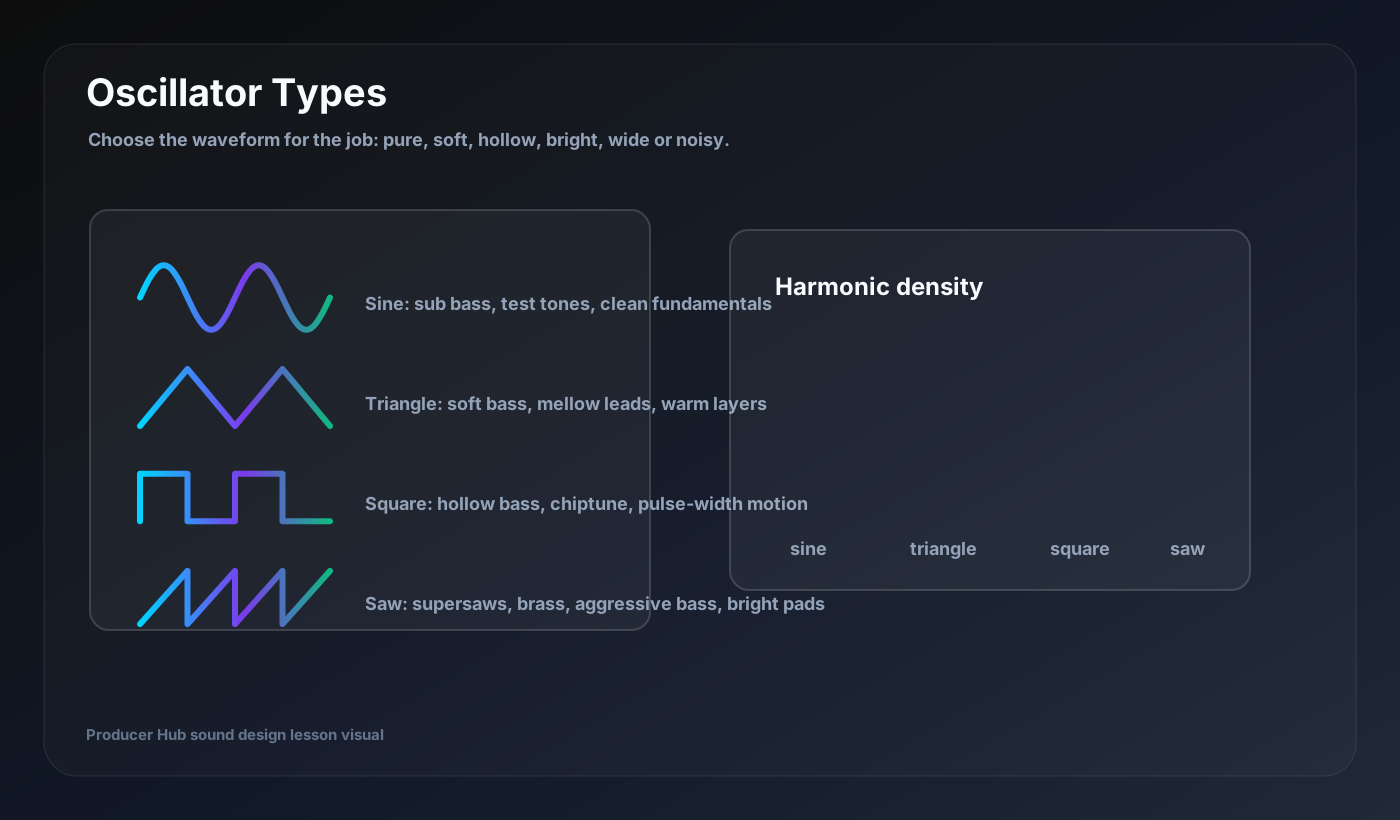
Oscillators are the start of most synth patches. They create the raw waveform before filters, envelopes and effects shape it into something musical. Choosing the right oscillator saves time because the patch starts close to the role it needs to play.
Sine waves
A sine wave contains only the fundamental frequency. It is smooth, pure and almost empty of harmonics. That makes it perfect for sub bass, clean low-end reinforcement, test tones, FM modulation and patches where you want controlled weight without grit.
Use sine waves when the mix needs stable low end. Do not widen a sine sub. If it vanishes on small speakers, add a quiet upper layer with saturation rather than making the sub itself messy.
Triangle waves
A triangle wave has odd harmonics that fade quickly. It sits between a sine and a square: more character than pure sub, softer than a square. Use it for warm basses, gentle leads, mellow pads and vintage-style tones.
Triangle waves are underrated for beginner sound design because they take filters and saturation nicely without becoming harsh.
Square and pulse waves
A square wave has strong odd harmonics and a hollow, bold tone. It works for bass, leads, chiptune sounds, organ-like patches and pulse-width modulation. Pulse waves are square-like waves where the high and low parts are uneven, creating animated movement when the width changes.
If a square patch feels too nasal, filter it, lower resonance or layer a softer waveform underneath.
Saw waves
A saw wave contains odd and even harmonics, so it sounds bright and dense. It is the starting point for supersaws, aggressive basses, brass-style synths, trance leads and many pads. Because saw waves already occupy lots of spectrum, they often need filtering and arrangement discipline.
Use saws when you need energy. Use fewer saw layers than you think, then make each one earn its place.
Noise and wavetables
Noise is not pitched in the usual way, but it adds breath, attack, air, risers, snares, impacts and texture. Wavetables move through many waveform shapes, which is why they are useful for growls, evolving pads, metallic tones and modern basses.
For beginners, treat wavetable position like a tone knob first. Move it slowly, then assign an envelope or LFO once you know which part of the movement sounds good.
Turn this into a patch-building drill
Open your DAW, build the patch from a blank synth, then save the result with a job-based name. The goal is not to copy settings blindly; it is to understand why every stage exists.
- Sine for clean sub.
- Triangle for soft harmonic weight.
- Square or pulse for hollow movement.
- Saw for bright dense energy.
- Noise for attack, air and FX.