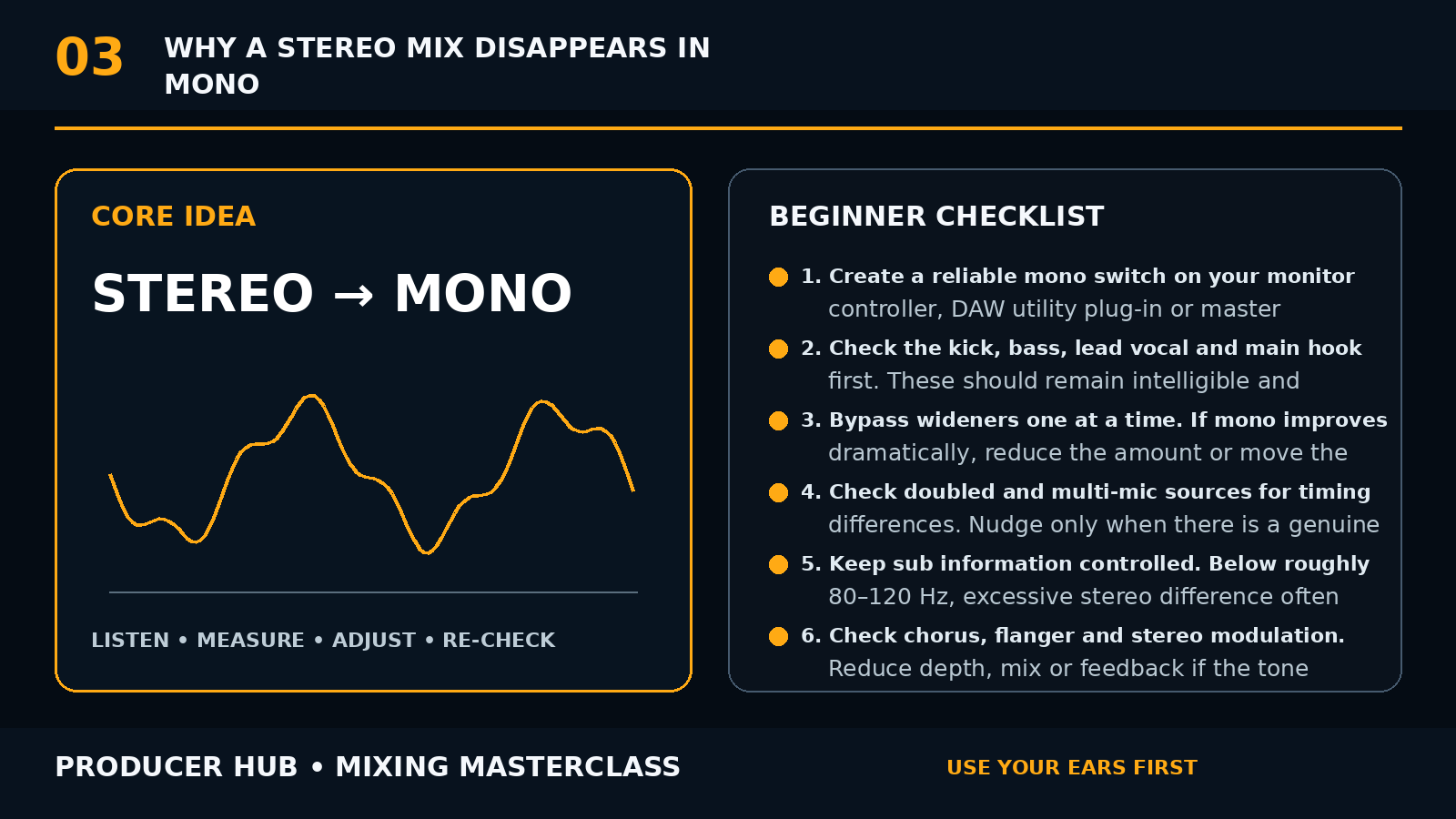
The Core Concept
Mono summing combines left and right. If similar waveforms arrive with opposite polarity or conflicting phase relationships, some frequencies can cancel.
A mix does not need to sound identical in mono. It should keep its important musical information, balance and impact.
The most vulnerable techniques are artificial width based on tiny delays, polarity tricks and highly decorrelated stereo processing.
Step-by-Step Tutorial
- Create a reliable mono switch on your monitor controller, DAW utility plug-in or master monitoring chain. Do not render the project to mono just to test it.
- Check the kick, bass, lead vocal and main hook first. These should remain intelligible and powerful.
- Bypass wideners one at a time. If mono improves dramatically, reduce the amount or move the effect to a less important layer.
- Check doubled and multi-mic sources for timing differences. Nudge only when there is a genuine phase problem; do not automatically align every performance.
- Keep sub information controlled. Below roughly 80–120 Hz, excessive stereo difference often creates unstable low end.
- Check chorus, flanger and stereo modulation. Reduce depth, mix or feedback if the tone collapses in mono.
- High-pass or narrow reverb and delay returns when they blur the centre.
- Use a correlation meter and vectorscope to locate suspicious sections, then confirm with your ears.
- Compare stereo and mono at matched loudness. Mono naturally feels less spacious, so judge balance and survival rather than excitement.
- Fix the source of the cancellation instead of adding EQ to the mono bus.
Common Mistakes
- Expecting mono to sound as wide as stereo
- Using polarity inversion as a widening trick on important sounds
- Ignoring stereo low-frequency information
- Fixing every timing difference and destroying natural doubles
- Only checking mono at the end
Guided Practice
Switch your chorus to mono and write down which three elements lose the most level or tone. Trace each one back to its stereo technique and redesign it so the musical role survives the sum.
Turn this lesson into a 20-minute mix drill
Duplicate
Save a copy of the session before changing the mix.
Solo less
Make every move while the main groove or vocal context is playing.
Level match
Bypass the change at equal loudness so louder does not trick you.
Export
Print a short before/after bounce and listen away from the DAW.