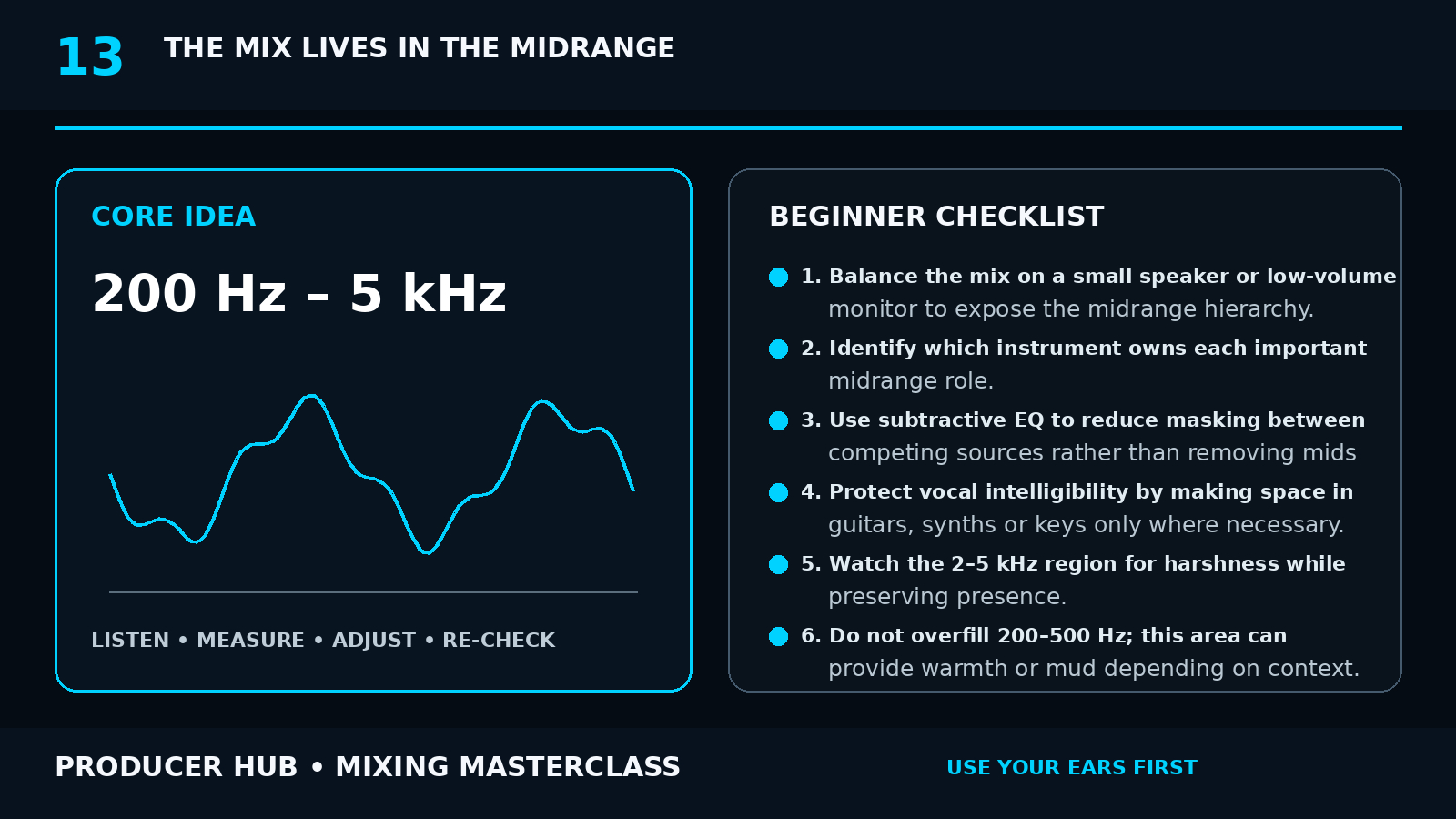
The Core Concept
The midrange contains much of the information that defines vocals, guitars, snares, keys and the character of many instruments.
Small speakers may reproduce limited sub-bass and air, but they still reproduce a large portion of the mids. That makes midrange balance critical for translation.
Scooping mids can sound impressive briefly but often removes clarity, impact and intelligibility.
Step-by-Step Tutorial
- Balance the mix on a small speaker or low-volume monitor to expose the midrange hierarchy.
- Identify which instrument owns each important midrange role.
- Use subtractive EQ to reduce masking between competing sources rather than removing mids globally.
- Protect vocal intelligibility by making space in guitars, synths or keys only where necessary.
- Watch the 2–5 kHz region for harshness while preserving presence.
- Do not overfill 200–500 Hz; this area can provide warmth or mud depending on context.
- Use automation to solve temporary masking instead of permanent deep cuts.
- Reference mixes at matched loudness.
- Check the mix without subwoofer emphasis.
- Make final decisions in context and at moderate level.
Common Mistakes
- Scooping the entire mix to sound “expensive”
- Boosting presence on every track
- Removing all 300 Hz from vocals and guitars
- Ignoring small-speaker translation
- Confusing midrange density with mud
Guided Practice
Temporarily band-limit your monitoring to roughly 200 Hz–5 kHz. Balance the song for clarity, then restore full bandwidth and adjust lows/highs without destroying the midrange hierarchy.
Turn this lesson into a 20-minute mix drill
Duplicate
Save a copy of the session before changing the mix.
Solo less
Make every move while the main groove or vocal context is playing.
Level match
Bypass the change at equal loudness so louder does not trick you.
Export
Print a short before/after bounce and listen away from the DAW.