The Core Concept
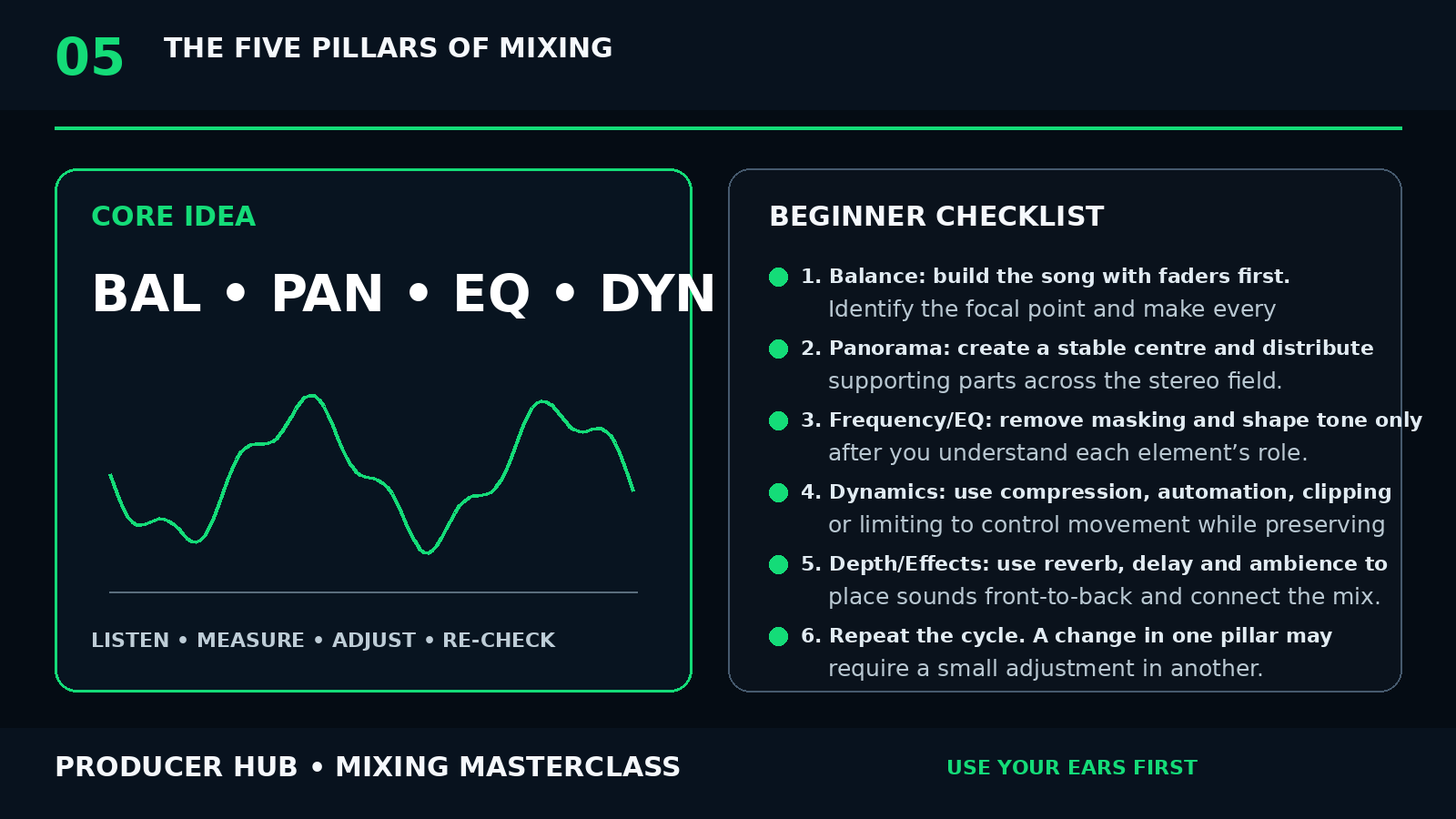
Most mixing decisions can be grouped into five areas: level balance, stereo placement, frequency balance, dynamic control and depth/effects.
The order matters because later processing cannot rescue a fundamentally poor balance.
Great mixing is decision-making, not plug-in collecting.
Step-by-Step Tutorial
- Balance: build the song with faders first. Identify the focal point and make every supporting element serve it.
- Panorama: create a stable centre and distribute supporting parts across the stereo field.
- Frequency/EQ: remove masking and shape tone only after you understand each element’s role.
- Dynamics: use compression, automation, clipping or limiting to control movement while preserving musical impact.
- Depth/Effects: use reverb, delay and ambience to place sounds front-to-back and connect the mix.
- Repeat the cycle. A change in one pillar may require a small adjustment in another.
- Reference frequently at matched loudness to keep perspective.
- Automate for sections rather than forcing one static balance to work for the whole song.
- Check on headphones, monitors, mono and a small speaker.
- Finish when the song communicates consistently; do not process simply because a slot is empty.
Common Mistakes
- Starting with the master bus instead of the faders
- EQing before understanding the arrangement
- Compressing every track by default
- Using reverb to hide poor balances
- Treating a reference as a tonal template instead of a reality check
Guided Practice
Mix one song using only faders and panning for 20 minutes. Then allow EQ, then dynamics, then effects. Notice how much of the final result was already determined by the first two stages.
Key takeaway: Use the technique with intention and make level-matched A/B comparisons. Settings are starting points, not fixed rules.
Turn this lesson into a 20-minute mix drill
1
Duplicate
Save a copy of the session before changing the mix.
2
Solo less
Make every move while the main groove or vocal context is playing.
3
Level match
Bypass the change at equal loudness so louder does not trick you.
4
Export
Print a short before/after bounce and listen away from the DAW.